




(But most leaders still don’t know how to build it)
Every leader I work with already knows that credibility starts on the inside.
They’ll nod earnestly and say things like, “It’s about who you are,” or “Credibility is built from within.”
And they’re right.
But then they hit the real problem:
They have absolutely no idea how to actually do it.
They don’t know how to translate inner values into outer behavior.
They don’t know how to turn good intentions into consistent action.
They don’t know how to rebuild trust when something slips.
They don’t know how credibility is formed, sustained, or repaired.
In other words:
Leaders understand the concept of credibility —
but they don’t understand the process of it.
That gap is where credibility erodes, teams disengage, and leaders wonder why people are no longer “on board.”
Credibility isn’t charisma.
It isn’t confidence.
It isn’t a leadership aura you either have or don’t.
Credibility is a system. It is intentional. It is behavioral.
And it can be built — consistently — when leaders understand how.
That’s why I developed two complementary frameworks:
The Credible Leader Framework™
The Credibility Ecosystem™
Together, they take credibility from vague aspiration to clear, teachable practice.
Let’s break them down.
The Credible Leader Framework™: How Credibility Forms From the Inside Out
Most leadership models start with outward behaviors — communication, influence, presence.
This one starts with the inner architecture that makes those behaviors credible in the first place.
The Credible Leader Framework™ has three layers:
1. Values — Who I Am at My Core
Your values shape your decisions, your reactions, your priorities, and your leadership identity.
They determine what you tolerate, what you correct, and what you stand behind when it’s inconvenient.
Values are not slogans on a wall.
They are the engine of credibility.
When leaders are unclear about their own values, their leadership feels unstable.
When leaders are grounded in their values, their leadership feels trustworthy.
2. Actions — Where My Values Become Visible
Credibility is built — or broken — at the behavioral level.
Your actions reveal:
- how you handle pressure
- how you communicate
- how you treat people
- what you prioritize
- what you ignore
- what you reinforce
No amount of strategic messaging will compensate for actions that contradict your stated values.
People don’t trust what leaders believe.
They trust what leaders demonstrate.
3. Accountability — The Practice That Makes Credibility Real
This is where credibility becomes durable.
Accountability means:
- following through
- owning your decisions
- acknowledging errors without excuses
- repairing the impact
- making tough decisions
- proactively closing loops
Perfection isn’t possible, but accountability is.
When leaders show accountability consistently, trust compounds.
When leaders avoid accountability, trust evaporates.
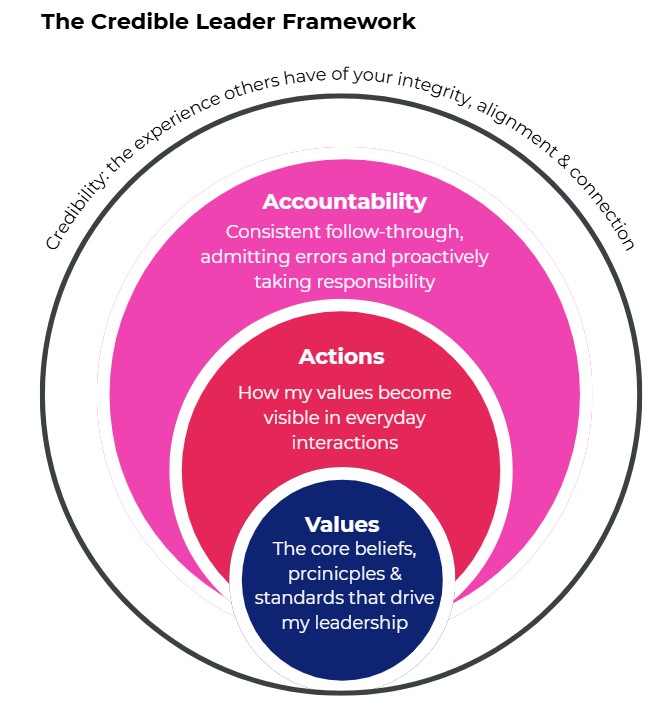
The Inside-Out Sequence
Values → Actions → Accountability
These three layers create the lived experience of who you are as a leader.
This is the inner construction of credibility.
But credibility is not only an internal structure.
It is also an external experience.
That’s where the Credibility Ecosystem™ comes in.
The Credibility Ecosystem™: How Others Experience Your Credibility
While the Credible Leader Framework™ explains how credibility forms within a leader,
the Credibility Ecosystem™ explains how that credibility is felt by others.
It is built on three interdependent forces:
1. Integrity — The Core Energy of Credibility
Integrity is the alignment between what you say, what you value, and what you do.
It is internal coherence expressed externally.
People experience your integrity through your steadiness, your honesty, and the predictability of your principles.
Integrity is where credibility begins — and where it breaks first if leaders drift.
2. Alignment — The Structural Evidence of Integrity
Alignment is how integrity becomes visible through consistent behavior and decisions.
When leaders’ actions match their values, people feel safe.
When leaders’ actions contradict their stated values, people feel confused or misled.
Alignment creates clarity.
Misalignment creates doubt.
3. Connection — How Credibility Is Expressed Interpersonally
Connection is the relational side of credibility:
- transparent communication
- empathy
- fairness
- civility
- psychological safety
- the ability to listen without defensiveness
Connection is where credibility becomes felt, not just observed.
It’s the difference between “I think you’re capable” and “I trust you.”
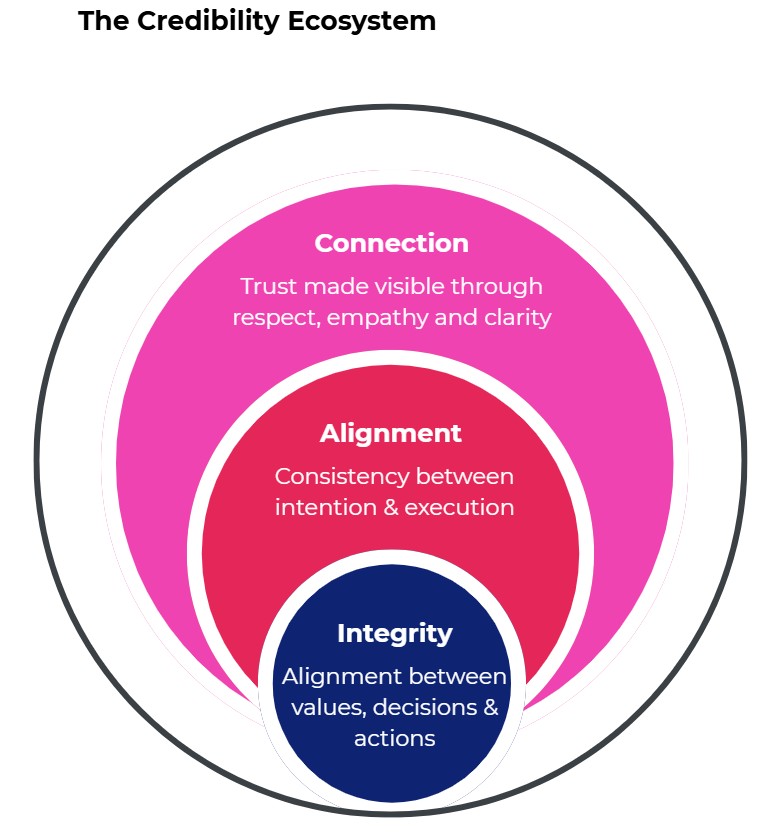
How the Two Models Work Together
The beauty of these frameworks is how seamlessly they reinforce each other:
Your Values inform your Integrity.
Your Actions become your Alignment.
Your Accountability strengthens your Connection.
Together, they create credibility that is:
- grounded
- consistent
- relational
- observable
- sustainable
This is credibility people can count on — not because you’re perfect, but because you’re intentional.
Why This Matters More Than Ever
Trust is fragile right now.
Noise is high.
Expectations are higher.
Employees and stakeholders can spot inconsistency instantly.
People don’t want leaders who are simply “authentic.”
They want leaders who are credible.
Leaders who know who they are.
Leaders who act with integrity.
Leaders who take responsibility.
Leaders who build connection even when conversations are difficult.
When credibility becomes intentional, leadership becomes transformational.



+ show Comments
- Hide Comments
add a comment